Thursday, May 20, 2010

Intermission

Friendship and Loss
Yasushi Kodama and Toshitake Nakayama (above) were both good pitchers for the always-a-bridesmaid Dragons teams of the late 50's, and, apparently, not enemies. The greatest of winners are not always the greatest of friends, and vice versa- but, for a short time, they had both it seems. Both Kodama and Nakayama had at least one twenty win season, but in 1959, the luck tipped in one direction.

According to Japan Baseball Daily, after Yasushi Kodama (or Soratani, as it has been spelled/translated as well [above, right]) won it all in the Koshien tournament, a bidding war broke out amongst the pro teams. He went to Dragons, which is not the usual outcome (most of these things end up with the Yomiuri Giants coming out on top), and pitched without pizazz in 28 games for Chunichi in 1954. He did, though, help them in some way make it to the Japan Series that year, and wound up getting on the mound for 1 inning (he struck out 2 of the 3 batters he faced).

The following year he was joined by Nakayama (also a Koshien winner [above, left]), who would find success much sooner than Kodama- after a rocky rookie season, he had two consecutive 20 win seasons. In those years ('56 and '57) he struck out 496 batters (combined) and had WHIP's of 1.05 and 0.99, respectively. However, the 570 or so innings he pitched wore down his arm (a bi-product of the overall pitching philosophy of that time), and by the next season he was losing more than he was winning, with an inflated ERA and WHIP.

By the time Kodama found his groove in 1959, the two time All-Star Nakayama was completely burned out. The friends that year shared the number 20- Kodama would win that many for the only time in his career, and Nakayama would lose the same, with a sad record of 9-20.

Despite his friends success that season, Nakayama joined an elite club of 20 game losers in the history of Japanese professional baseball (sixty-two overall) that, while not matching or mirroring the losers of the American Major Leagues, illustrates the common bond between winners and losers in baseball.

There have been 482 MLB twenty-loss seasons but only one since 1980 (Mike Maroth lost 21 in 2003 for the Tigers), as well as fifty 30 or more loss seasons, none of which was in the 20th cent. The record for the 20th cent. belongs to Vic Willis with 29, though the more modern records belong to Paul Derringer (with 27 in 1933) & Roger Craig (with 24 for the '62 Mets).

No NPB players have 30 losses in a season, but 62 have put together 92 twenty-loss seasons. All of those seasons with 26 or more losses occurred between 1940 and 1957- a trend that shows how much later teams in Japan continued to "get the most out of" their pitchers (though this also most likely a bi-product of the late founding of professional baseball in Japan- a full 60 years after MLB).

The first to lose 20 games was Toshihide Hatafuku in 1938, and the last was Osamu Higashio in 1977 (he is also the most recent pitcher to be inducted to the Hall). In fact, the most consistent 20-game losers are some of the greatest in the history of the game. Only four pitchers have lost 20 or more in at least four seasons (and one, Masaichi Kaneda, did it six times- though he is the all time leader in both wins and losses), and all but one are Hall of Famers (Yasuo Yonekawa being the lone exception).

Yasuo Yonekawa (left) can boast of three 20 win seasons to counter his losses, and his 132-142 lifetime record overshadows his excellence as a pitcher. His 2.81 ERA was the 9th best of all time at the time of his retirement, and he was a 4 time all-star with 1346 K's (enough to put him in the top 10 at the time of retirement as well). He is a step or two away from being on the doorstep of the Hall of Fame, but his career success is much more impressive than his .481 winning percentage.

These figures says a lot about the history of the game- for decades pitchers were used and abused, arms were destroyed and innings racked up. Top that off with few relievers and not a lot of run support. Speaking of the '58 All-Japan team (see the April 25 post on this blog), it was Inao who won the (first) of two games, after a season during which he pitched 373 innings, notched the second of three straight 30-win seasons, and single-handedly corralled the Japan series by winning the last four games while working 47 series innings. They did call him the Iron Man, but that mentality was not outside the norm.

Loss is something we all fear at some point, and it occasionally provides the imputus for seeking out friendships. But loss is just a part of winning, as we see here, and friendship, and everything else.

Otomo Update

A Noboru Aota Fan's Notes recently featured a short piece on Takumi Otomo in a larger article on . He was the key man in the rotation for Shigeru Mizuhara's Yomiuri juggernaut of the mid-50's. While perusing Jim Albright's excellent analysis of baseball in Japan, we came across more support for the Otomo-for-the-Hall argument.

Otomo is listed as the number six best player in the Central League during the 50's, but more impressive is Albright's application of Fibonacci win points to Otomo's career. He comes out as the number 22 pitcher of all time, surrounded by Yutaka Enatsu, Choji Murata and Juzo Sanada.

Though Albright does not provide and outright endorsement for his Hall candidacy (one argument- his career is too short), but, at least, it shows that Otomo needs to be in the conversation more than he has.

Kim Young Joong

Coming soon is part II of our coverage of the 1958 tour of Japan by the St. Louis Cardinals. Part II will feature not only the stars of the Central League who made the cut for the All-Japan team that took on the Cards, but also a series of articles written by Jim Brosnan for the St. Louis Post Dispatch about the tour. Though the majority of that tour took place in Japan, it began in Hawaii and quickly moved through South-Eastern Asia before landing in the Land of the Rising Sun.

One such stop was in Seoul, South Korea (after making a brief appearance in Japan)- Brosnan comments on the poverty that greeted them and guilt felt by some of the players for passing through in their grandeur (modest, of course, by today's ballplayers means). He also points out a story of heroics equal to that of Eiji Sawamura in the story of Kim Young Joong. Described only as a "Korean major", Joong struck out the great Stan Musial to the roar of the crowd. According to Brosnan, "he caused Synghman Rhee, the Korean president, to leave the park. That little pitcher could have run for mayor."

Does anyone know any more on Joong, or if he ever went on to pitch professionally? If there is any info on Joong out there please contact and enlighten us!

Coming soon, more on the tour and the articles in the Post Dispatch (see below- a welcome to the Cards from a Japanese paper, clipped and sent by a young guide to the team [Kazuyooi Aoki] and published in the Post Dispatch).
Special Thanks to the St. Louis Public Library Special Collections for their excellent help in finding this material and making it available.!

Thursday, May 13, 2010

Ken Burns and Ichiro

Inning 10 of Ken Burns' Baseball will debut on PBS at the end of the 2010 mlb season. It will include a sit-down interview with Ichiro- read more on Kieth Olbermann's blog here.

Coming soon- more coverage of the 1958 Cardinals tour of Japan...

Sunday, April 25, 2010

Specializing in Terrific Shoots

Cardinals in Japan, pt. 1

In the next year or so, Rob Fitts will be releasing a book chronicling the American baseball tours of Japan in 1931 and 1934. These influential tours not only inspired the formation of the Japanese pro league, but also set the standard for further tours of Japan by American ballplayers. By the 50's, the touring teams were made up of a single team as opposed to barnstorming all-stars- below is a list of the teams to tour Japan in the 50's, beginning with the famous Seals tour of 1949.

San Francisco Seals 1949
Major League All Stars 1951
Eddie Lopat All Stars 1953
New York Giants 1953
New York Yankees 1955
Brooklyn Dodgers 1956
St. Louis Cardinals 1958

After ten years of New York all-stars, the Cardinals tour of '58 stands out. They played 16 games all throughout Japan, all against a Japanese all-star team (as opposed to just playing the Yomiuri Giants, who had been the usual competition). Sure, St. Louis had Stan Musial and gang, but they were really a team of more ordinary players up against the best Japan had to offer.

Invited by Ysetsuo Higa, the Cards brought with them approximately 50 people, led by Bing Devine (GM), Art Routzong (business manager) and newly appointed manager Solly Hemus. On October 10 the left for the Pacific and headed straight to Hawaii (where they faced an all-star team that included Eddie Matthews, Lew Burdette and Bob Turley) before moving around the Pacific Rim into Japan. Below is the itinerary:

Oct. 11 Kahului, T.H.
Oct. 12 Honolulu, T.H.
Oct. 13 Honolulu T.H.
Oct. 18 Manila P.I.
Oct. 19 Kadena AFB Ok.
Oct. 21 Seoul Korea
Oct. 24 Tokyo
Oct. 26 Tokyo
Oct. 27 Sendai
Oct. 28 Sapporo
Oct. 30 Nagoya
Nov. 2 Nishinomiya
Nov. 3 Osaka
Nov. 4 Osaka
Nov. 6 Hiroshima
Nov. 8 Fukuoka
Nov. 9 Shimonoseki
Nov. 12 Shizuoku
Nov. 13Mito
Nov. 15 Tokyo
Nov. 16 Tokyo (a.m. and p.m. games)

Musial did not joint the team until arriving in Japan, and he felt he disappointed the Japanese fans with his performance- though he hit over .300 he knocked only two out of the park. What really impressed the Hall of Famer was the fact that the Central and Pacific leagues had decided to put together an all-star team with the hopes of, as Musial said, 'winning 5 of the 16' games against them. (He was also impressed with the control of the NPB pitchers, but not so much with their hustle, or lack-there-of.)

The resulting Japanese all-star team was saturated with the star-power of two golden ages of baseball in Japan, the post-war and V-9 eras. The team was centered around the Golden Boy, the rookie Nagashima, who was coming off a Rookie of the Year performance. However, they were stocked full of future Hall of Famers and superstars.

Led by the ever-competing managers, Osamu Mihara and Nobuyasu Mizuhara (whose mythically contentious relationship leads one to believe that there was little consensus on any decisions made during the series, even though they were managing on alternating days), the stars of 1958, all assembled, were a team to rival the 1934 all-star team for skill and legend. The Mainichi Shimbun, who had sponsored the tour, presented an overview in October of the players plucked from both the Central and Pacific Leagues- not too long after the Lions edged out the Giants in that famous Japan Series contest. The teams are listed as follows (players with an [H] are in the Hall of Fame):

Managers:
Osamu Mihara 60 Lions [H]
Nobuasu Mizuhara 30 Giants [H]

Pacific League:

Pitchers:
Kazuhisa Inao Lions [H]
Tadashi Sugiura Hawks [H]
Matsuo Minagawa Hawks
Takao Kajimoto Braves [H]
Tetsuya Yoneda Braves [H]
Atsushi Aramaki Orions [H]
Masayuki Dobashi Flyers
Bill Nishida Flyers
Mamoru Otsu Pearls

Catchers:
Hiromi Wada Lions
Katsuya Nomura Hawks [H]
Takeshi Yamashita Braves

Infielders:
Futoshi Nakanishi Lions [H]
Yasumitsu Toyoda Lions [H]
Kingo Motoyashiki Braves
Roberto Barbon Braves
Takao Katsuragi Orions
Kihachi Enomoto Orions

Outfielders:
Kiyoshi Sekiguchi Lions
Shigeo Hasegawa Hawks
Kohei Sugiyama Hawks
Kazuhiro Yamauchi Orions
Takao Yoto Orions
Shoichi Busujima Flyers
Jack Ladra Flyers

Central League:

Pitchers:
Motoji Fujita Giants [H]
Sho Horiuchi Giants
Masaaki Koyama Tigers [H]
Hiroomi Oyane Dragons
Toshio Nakayama Dragons
Shoichi Kaneda Swallows [H]
Motoichi Murata Swallows
Noboru Akiyama Whales [H]
Takashi Suzuki Whales

Catchers:
Shigeru Fujio Giants
Atsushi Doi Whales

Infielders:
Tesuji Kawakami Giants [H]
Tatsuro Hirooka Giants [H]
Shigeo Nagashima Giants [H]
Yoshio Yoshida Tigers [H]
Hideshi Miyake Tigers
Noboru Inoue Dragons
Atsushi Hakoda Swallows

Outfielders:
Wally Yonamine Giants [H]
Andy Miyamoto Giants
Kenjiro Tamiya Tigers [H]
Atsushi Otsu Tigers
Toru Mori Dragons
Katsuji Morinaga Carp

There are 20 Hall of Famers on that list, but what stands out is all of the talent that has yet to be recognized by the Hall- some of the best players of the 50's. The Mainichi Shimbun preview featured short bios of each of the players to earn a spot on the team. Below is a look at those Pacific League Stars, with help from the Mainichi bios.

The Pacific League- Pitchers

To begin with, most of the pitchers from the Pacific League ended up in the Hall- only Otsu, Nishida, Minagawa and Dobashi remain un-recognized.

Matsuo Minagawa (pictured above) is obviously the most deserving- his lifetime record of 221-139, combined with a 2.42 ERA and 1.06 WHIP are evidence enough. However, he only won 20 games once (albeit with a record of 31-10), and was never recognized with a Sawamura award. The Card's tour was on the heels of his first superstar-like season: the Mainichi reports, A lanky fellow, he joined the Hawks immediately after leaving high school. This season, he ended up with 17 wins, eight losses. The righthander showed his finest pitching against the top teams- a real money player. He is a sidehand pitcher, specializing in terrific shoots.


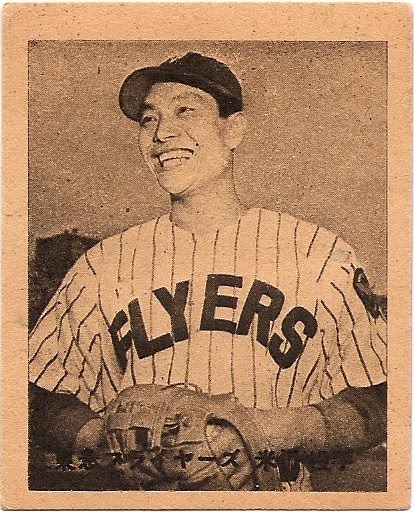
Those terrific shoots helped earn Minagawa a spot with the aces of the Pacific League squad, and Masayuki Dobashi (left) wasn't far behind. Dobashi, who is described in the paper as the ace of the Flyers pitching staff, was discussed in our Hall of Fame post from earlier this year. The addition of Dobashi makes 7 Hall of Fame or near-hall-of-fame pitchers on the staff of the Pacific League side of the team

St. Louis got off to a good start in the first two games, but it was the the two aces from the Pacific League, Inao and Sugiura, who were able to beat St. Louis, by scores of 6-3 (Inao) and 9-2 (Sugiura) in the third and eighth games, respectively. However, the other fourteen belonged to the Cards (attendance in parentheses, Japan team wins in bold):

Oct. 24 Tokyo 5-2 (25,000)
Oct. 26 Tokyo 8-2 (20,000)
Oct. 27 Sendai 3-6 (25,000)
Oct. 28 Sapporo 9-1 (30,000)
Oct. 30 Nagoya 7-2 (20,000)
Nov. 2 Nishinomiya 6-1 (33,000)
Nov. 3 Osaka 6-3 (50,000)
Nov. 4 Osaka 2-9 (25,000)
Nov. 6 Hiroshima 6-3 (20,000)
Nov. 8 Fukuoka 5-1 (30,000)
Nov. 9 Shimonoseki 7-1 (20,000)
Nov. 12 Shizuoku 8-0 (20,000)
Nov. 13Mito 5-1 (20,000)
Nov. 15 Tokyo 9-2 (20,000)
Nov. 16 Tokyo (a.m.) 8-2 (40,000)
Nov. 16 Tokyo (p.m.) 4-2 (40,000)

The Players

The obvious star (from the Japanese perspective) of the entire 16 game tour came from the Central League- Rookie of the Year and future Mr. Baseball Shigeo Nagashima. However, the year before, though he had been the star of the Big-6 University league, his team captain at Rikkyo had been Kingo Motoyashiki (above, with Minoru Murayama, who would not make his debut until the following season), now the starting shortstop for the Pacific League Braves with a spot on the All-Japan team.

Kingo Motoyashiki was, according to the Mainichi, sold short by most experts before the [1958] season opened. It was a poor prediction. He played in every game of the season for the Braves (the only one in the Pacific League to do so), and tied teammate Chico Barbon for the lead in triples with 10. His .260 average was respectable (helping him to score 49 runs), but it was his glove that really made him valuable. Always regarded as a brilliant fielder, he showed that he can hit in the pinches, too.


Motoyashiki (left) led all shortstops in the Pacific League in every category, and led all infielders in assists with 418. Only Barbon edged him out in putouts for middle infielders- with those two up the middle, the Braves generally were at the top of the league in terms of runs given up. However, they were also usually at the bottom in runs created, and during Motoyoshiki's tenure the team never won a pennant. He would continue to shine for Hankyu, earning two trips to the All-Star game, until 1964, when he moved to the Hanshin Tigers and helped them to the Japan Series. He joined Hall of Famer Yohio Yoshida to form a powerful plug up the middle, as well as add some stability to Hall of Fame Manager Sadayoshi Fujimoto's constant platooning- two changes that brought the Tigers to game seven of the Series, though they lost to MVP Joe Stanka in the end. Motoyoshiki got only three hits, and for the next five seasons saw less and less action. He eventually became a coach and broadcaster.

The other shortstop from the Pacific League was Takao Katsuragi. Nineteen-Fifty-Eight was his breakout season- to quote the Mainichi, One of the biggest news of Japan pro baseball this season has been the amazing performance of this rough and ready performer. At press time he was batting .306 and had slammed out 20 home runs beside showing remarkable improvement in fielding, a weak spot in other years. This year he was the Runs Batted In champion of the league.

Katsuragi (right) had been stellar at 3rd base for the Orions in 1957, leading all third sackers in assists and double plays as well as hitting for the cycle in August, but he was moved to short for the '58 season. Though he held his own in the field, his offense picked up, leading the league in hits and rbi (as he would do again in '59), and he was voted to the Best 9 for the first of two consecutive years. He was a 5 time All-Star, and his 174 lifetime home runs are high on the list for those that spent their careers in the middle infield.

The games were well attended in Japan (a total of 438,000 fans turned out in all) as well as nationally televised. Some of the games were even carried, in a delayed broadcast, on KMOX in St. Louis. Joe Garagiola, former Cards catcher and future Today Show stud, even traveled with the team through Japan taping the games to be broadcast later. However, the good international good feelings were not felt by everyone.

Rob Fitts points out that it was during the tour that Yomiuri Giants president Kazue Shinagawa made an important announcement. "Japanese baseball should be played by Japanese players and we have no intention of signing up new foreign players in the future." The Giants had been the first team to really embrace Gaijin and Nisei players in the post-war era, first with Wally Yonamine, then with Andy Miyamoto and Dick Kashiwaeda. Yonamine and Miyamoto made it on to the '58 team, but they were nearing the end of their careers and soon would be replaced by Shinagawa's idea of 'pure' players.

The rest of the league did not follow suit, and more and more foreign players would find success in Japan, with Joe Stanka becoming the second Gaijin MVP for the Hawks in 1964. One of the early Nisai to go across the sea (the 42nd) was Jack Ladra, who landed in the outfield of the all-star team against the Cardinals.


Ladra (left) was born in Hawaii and went to Fresno State before joining the Flyers in 1958. Like many of his fellow Americans, the Japanese fans were impressed with his aggressiveness and speed, and he finished the season in the top 10 in stolen bases, triples and doubles. His steady play in both the infield and outfield helped the Flyers steadily climb through the Pacific League until, in 1962, they edged out the Hawks for the pennant. Though he did not help out too much at the plate, his presence in the outfield no doubt helped the Flyers to their only Japan Series title. He had set a Pacific League record that year for most defensive chances in a game, his glove having proven to be his weapon of choice for the entire season. He led all Pacific League outfielders in putouts and assists. He was tied for the league lead in triples in '64 and ended his career with 32 in only 2307 at bats, the same rate as all time leader Yutaka Fukumoto.


In the outfield only one of the Pacific League stars, Kazuhiro Yamauchi, made it into the Hall of Fame- all the others wallow in in NPB obscurity. Besides Ladra, who had a decent career in Japan, there were Kiyoshi Sekiguchi (One of the most dependable veterans on the powerful Lions team, he batted .276 and hit 16 home runs this season. Slightly weak against curves, he never lets a good one go by. A 10-year veteran of veterans), Shigeo Hasegawa (...today he is one of the heaviest hitters on a heavy hitting nine), and Takao Yato (A former infielder, he was transferred to the outer garden this season with outstanding success, batting .286. Always considered as having infinite promise, he is rapidly rounding into form). But the shining star of that forgotten lot is Shoichi Busujima, the one star from the all-star team that deserves a plaque more than anyone else.

The 1962 Series, that featured both Ladra and Dobashi (who was also MVP of the series), also saw a Game 3 home run by Busujima, who was in the middle of his stellar, almost 20 year career with the Flyers. When he retired in 1971, his 1977 hits (only 23 shy of the magic number of 2000 that would give him entry to the Meikyukai, or Golden Players Club) placed him 6th on the all-time list, only one behind Hall of Famer Tokuji Iida. More importantly, he was the all-time leader in triples- two years earlier he had tied the original Mr. Tiger Masaichi Kaneda for tops on the list, and had passed him by three in 1970.


Though Busujima (above) was eventually passed by stolen base champ Yutaka Fukumoto, he remains second on the triples list with 106. As an outfielder, he was always in the top 5 in putouts and assists, and in '58, though trailing Ladra in most categories, he led all Pacific League outfielders in double plays with 4. To quote the Mainichi in 1958, coming from a famous high school team, he is the outstanding batter of his team, hitting .306 this season. Although not the aggressive type, he is a smart batter able to hit to all fields. An All Star player. Eight times an all-star, that is, with a .381 average in 18 games according to Japan Baseball Daily. Voted to the Best 9 three times, Busujima's career deserves more attention as well as votes towards the Hall.

Of the top five batters in the PL in '58, Busujima was second, Katsuragi third and Kohei Sugiyama fifth. Sugiyama began his career with the Kinnetetsu Pearls, but made his mark with the Hawks. He was a three time all-star in Hankyu, and led the - The traditional Japanese Baseball calendar consists of 130 games, but the Pacific League experimented with a longer schedule during the mid '50s, culminating with a 154 game set in 1956. Sugiyama, one of the few stars to play in every game that season, still owns the record (tied with two others) for games played in a season. He had performed admirably for the Hawks for the first six seasons, hitting .303 with 93 rbi in '56, but in '58 he was the "big hitting star of the Hawks" according to the Mianichi, a medium range batter, noted for his cunning at the plate.

Sugiyama's best seasons were still to come- the greatest of which was 1961, when he finished with a .321 average, a .496 slugging percentage with an OPS of .884. He slugged 15 home runs and led the Hawks to the Japan Series, where he hit one more homer and scattered 5 hits with 3 rbi. Sugiyama was the Mr. October of the Hawks franchise, playing in six different series, with 78 at bats and 20 hits. In fact, after the '61 postseason, he spent two seasons with the Braves (with whom he is pictured at right). During those two Sugiyama-less seasons, the Hawks would finish second in the PL. Upon returning in 1964, he would provide, or provide again, the spark that would lead them to the Series for the next three seasons ('64-'66). Though not the greatest outfielder in the world, Sugiyama held his own each season, occasionally leading the league in double plays and, in 1958, coming in second with a .986 fielding percentage.

During the trip, several of the American pitchers were offered large contracts to stay and pitch in the Japanese league. Phil Paine had pitched a previous stint for the Nishitetsu Lions in '53, where he was one of the first former MLB players to suit up in Japan (his BR page states incorrectly that he was the first, but in a previous post on this blog Leo Kiely was stated as being the first- Kiely's debut for the Orions was on August 8, 1953, according to Japan Baseball Daily, and Paine's was on August 23rd, according to the BR page, making him the second), and had come back to put together a short major and minor league career in the US. 1958 would prove to be Paine's last stint in the show, but he would stick around a few more years in the PCL. He, along with Bill Wight, at the end of a long career himself, declined to stay.

The third Cardinal offered cash to stay was Jim Brosnan, at the beginning of his career as a mildly effective journeyman pitcher. He turned down the offer as well, thinking of his family- it was a good move. His 1959 season would prove excellent fodder for the first real baseball memoir, The Long Season, which laid the groundwork for future controversial 'tell-all's' like Jim Bouton's Ball Four. Brosnan's writing talents were know by the time of his tour of Japan, and he was approached by Bob Creamer of Sports Illustrated to write a series of articles about the goodwill tour. When Bob Broeg of the St. Louis Post Dispatch learned of the agreement, he offered Jim 100 dollars each for a series of articles on the same topic.

He wrote, they published, and the teams continued to play. Coming soon in Part II of "Specializing in Terrific Shoots", more on the Brosnan articles and the stars from the Central League.

Tuesday, March 16, 2010

For the Giants/Against the Giants

Between 1950 and 1979, everyone in the Central League who won the MVP ended up in the Hall of Fame. Everyone, that is, except for Takumi Otomo (left). Otomo pitched brilliantly for the Giants from 1951 to 1956, teaming with Tekehiko Bessho, Hideo Fujimoto, Hiroshi Nakao and so many other greats that only the Yomiuri Giants could attract.

In those years, when the Giants won the pennant every season except for in '54, Otomo and Bessho were the aces of the staff, each having 30 win seasons, dominating the competition and winning a gaggle of MVP's- Otomo's came in '53, while Bessho earned two, in '52 and '56.

And while Bessho had his no-hitter before the war, it was in 1952 that Takumi Otomo pitched his, contributing to what may have been the best team in the history of baseball in Japan. Kawakami, Aota, Chiba, Yonamine, Hirai, Minamimura, Fujimoto, Nakao, Bessho and Otomo. The Giants led the league in almost every hitting and pitching category, finished three and a half games ahaed of the Tigers in the Central League, and breezed by the Hawks to win the Japan Series. And on July 26 of that year, Otomo no-hit the Robins in the most lopsided no-hitter in the history of Japanese Baseball- a 17 to 0 romp that no doubt showcased the immense hitting talent of the '52 Giants.

From '53-'56, his numbers were astounding:

27-6 1.85

21-15 1.68

30-6 1.75

12-7 1.63

1953 proved to be Otomo's most glorious season. He was the finest pitcher on the Giants staff, leading them in every pitching category and to the Japan Series, where he won the seventh game and was named 'Outstanding Pitcher'. At season's end he was named to the Best 9 and voted MVP. However, his most outstanding performance came against the NY Giants in a post season exhibition series where he pitched a complete game victory and compiled 15 strike outs in 25 innings. He was so impressive that, according to Rob Fitts, New York tried to acquire him (an attempt that, had it succeeded, would have made Otomo the first Japanese to play in the MLB, ten years before Masonori Murakami). However, Yomiuri demanded too much in return, and the Giant-to-Giant trade never materialized.

He had similar success against the Dodgers in '56, as well as against teams in Mexico, Panama and Colombia during the Giants tour through Latin America (see Wally Yonamine: The Man Who Changed Japanese Baseball for more on that tour).

It was in 1956 that, according to Japan Baseball Daily, he was hit on the thumb by a pitch from Mitsuo Osaki that effectively ended his dominance. From then on, he could not get the right grip on the ball and faded quickly. His last great appearance came in relief at the end of the first game of the 1958 Japan Series, where he picked up the win- however, the scattered innings that followed only cemented his position as being a pitcher past his prime.

He lost a year, and returned in 1960, where he pitched 20 innings with Kinetetsu (managed by [and named after] his former Yomiuri teammate Shigeru "Formidable Buffalo" Chiba) in what appears to be a comeback attempt. But he was unable to muster much in the fifteen games he pitched for the last place Buffalos. He finished his career 130-57, with a 2.11 ERA and a 0.97 WHIP- numbers that make at least some case for a HOF bid that will place him along with his fellow Central League MVP's.

The 1958 Japan Series was a disapointment, for the Giants as well as Otomo, but it signaled the changing of the guard. The star, despite being on the losing team, was the rookie, Shigeo Nagashima- his brilliant play would usher in a new era of greatness in Japanese baseball. But following that series, the greats of the 50's played one last exhibition series against MLB stars. They didn't have the master- Otomo- yet the team fared well. Stay tuned for an analysis of the 1958 St. Louis Cardinals visit to Japan, and some of the forgotten All Stars who played against them...

Hachiro Maekawa 1912-2009

Hachiro Maekawa, last surviving member of the original 1936 Yomiuri Giants (when he played with Seiichi Hayashi) as well as a teammate of Noboru Aota's on the 1946 Hankyu Braves, died today. He was 97. Please see a short bio and link to his first pitch ceremony here.
1946 or 1947 Hankyu Team

Saturday, March 6, 2010

"Baseball has some kind of magic"

(Noboru Aota Strikes A Pose)

In Japan as well as in the US, the Hall of Fame is where baseball's magic and myth is most celebrated and propagated. We are now in full swing of Awards Season: the Hall of Famers have been announced, and now up are the Oscars, about which Federico Fellini said:

"...a vaguely funeral fashion parade, a ceremony in many ways like a carnival, but at the same time a moving and pathetic spectacle, organized with the fullest awareness of what it was and is. Notwithstanding the clamor it excites, it is a private ceremony; it's cinema encountering itself in an attempt to resuscitate the dead, to exorcise wrinkles, old age, illness and death. It has the same fascination as caricature; it is a caricature of the Day of Judgement, the Resurrection of the Flesh. Those like me who accept the mythology of the cinema cannot refuse a prize like the Oscar. To dispute the award seems to me ridiculous and childish. The cinema is also circus, carnival, funfair, a game for acrobats."

Did any player accept the mythology of sport, or embrace it, like Fellini? Or is it only us, the fan, the writer, the historian of the sport (any sport), that clings to it?

If there is any place that compares with the Oscars in sports, it is the Baseball Hall of Fame in Cooperstown. The mythology of the sport thrives in the the halls at Cooperstown, and the history of voting there represents the strange and self-aggrandizing nature of that mythology. As hard as it may be to visualize now, those that we think of now as fully part of the myth required the time to build their story (or have their story constructed), and, in turn, their safe place in the circus.

Sometime in early 1949, 153 members of the Baseball Writers Association looked over the ballot for the Hall of Fame, flooded with legends: the top vote getter's that year were Charlie Gehringer, Mel Ott, Al Simmons, Dizzy Dean, Jimmy Foxx, Bill Terry, Paul Waner and Hank Greenberg. Not one of them was chosen. The argument is that, with so much talent, none of the writers could focus their votes enough to give any one player more than 75%- and than makes sense.

Now, sometime in 1953, many of those same writers (264 in all) sat down with another ballot, stocked with a similar overflow of talent- this time, however, they were able to agree (or, at least 75% could) on Dizzy Dean and Al Simmons as worthy of immortality. Near the top of the list are many who ended up in the Hall, one of whom is Ted Lyons, a 260-230 pitcher with 1073 strike outs in his career- an understandable player to be passed over several times before induction.

What is very interesting, though, about that 1953 ballot, is that Lyons' 139 votes (52%) were 22 more than were bestowed upon Joe DiMaggio. Joltin' Joe would be passed over one more year before finally earning enough votes (233, or 88%) to be enshrined. Yes, the rules were somewhat different then, and yes, DiMaggio was not the sportswriters' best friend, and yes, many great players were passed over in those early days (and even Cy Young was not voted in the first class). But what is most interesting is that, more so than any of the other players listed above (including Young), DiMaggio has a legendary aura about his name, and is revered today in a light closer to Deity than human. He seems above even the steady path to the Hall of Fame that is so accepted for the other heroes of the game- was he then just as 'average' as those other heroes? Has time created a DiMaggio in our imagination that did not exist then, given how much of a star he was (think of his trip to Japan with Marilyn)? And how much did Joe contribute to the building of his own myth- how much did he care about his place in the Hall?

This is where the mythology has grown and still grows: His seems to follow the same path as the beautification of a martyr, on the way to sainthood. Is he only the legend we revere because of Paul Simon, or because we need to constantly create Gods and Heroes to worship? Is the Hall of Fame, as Fellini said of the Oscars, an attempt to resuscitate the dead? Is it baseball encountering itself?

The Hall of Fame in Japan is cut from the same mold, though the cultural differences only enhance the "caricature". So, why did it take Noboru Aota so long to get in to the Hall- how was his myth built, or how was it broken down? His playing career was Hall of Fame worthy- he was at the top of the heap for almost two decades, and the all-time home run leader at the time of his retirement. We know from his wife that he wanted to be there- it doesn't seem abnormal that he or anyone else would want to be enshrined, deified, in any Hall. It was the time after his retirement, and the myth that built around him in spite of himself, that kept him out of the Hall. There are no sure fire Hall of Famers in Japan- just look at three time triple crown winner Hiromitsu Ochiai, whose 'bad' behavior seems to still resonate with the voters.

Even Hiroshi Oshita (left) was not a shoo-in: arguably the best player of the late 40's and early 50's who nonetheless did not get the 'Call from the Hall' until after his death many years into retirement. But it was Oshita, Takehiko Bessho, and Aota that were the terror of the Ginza, a couple of 'bad boy's' and drinkers when they were together in the 40's: that perception persisted for all three, and though they all retired before 1960, neither Oshita or Bessho would be Hall of Famer's until 1980. For Noboru Aota, an incident that occurred at that same time prolonged his wait even further.

It was in 1959 that Aota played his last game with the Hankyu Braves, the team that had taken him in after WWII. But it was the Whales who had given him a home, and it was the Whales to whom he would eventually return and manage. But first, Aota worked for Hochi Sports as columnist and commentator in 1960 after retiring from the game. It was the beginning of a broadcasting career that would eventually bring him more lasting fame to many Japanese than his playing career.

However, he could not stay away from the field, and soon made his way back into the dugout with the Tigers in 1962. That year Hanshin made it to the Japan Series for the first time, winning their first pennant since the late 40's. In his capacity as hitting coach, Aota did not improve much- the Tigers offense remained consistently poor, ranking at the bottom of the league in runs produced and home runs, similar to the previous year. It was their fantastic pitching, with the lowest ERA and WHIP in the league, that brought them the pennant. Though they lost in the series, HOF'er Yoshio Yoshida was awarded 'best hitter', a feat for a light hitting SS that must be, in part, attributed to Aota's teaching. However, something in his performance persuaded him to move back to broadcasting, and for the next two seasons he was calling games on Nihon TV before getting back into uniform for his post-war bosses Hankyu. Within 3 years he was able to aid Braves hitters enough to put them in the league lead for home runs- feat that would bring them the pennant that year, 1967, the first in a string of winning seasons.

He continued on as a broadcaster on-and-off through the end of the 60's and early 70's until his old team came calling and he joined the Whales as a coach in 1972. It wasn't long until Karao Betto, who had been manager of the Whales since he had replaced Osamu Mihara four years before, was replaced himself with Aota. From late August until the end of the season, Noboru Aota earned his chops in his first managerial gig, though he lost 14 of 17 before seasons end.

1973 was his only full season managing at the pro level, and though he did not finish last (and brought the Whales close to .500, an improvement from the previous year), his year was marred with enough problems to earn him a pink-slip once it was over. His inability to relate to players led to an 'anti-Aota' sentiment on the club, and the animosity may have contributed to the poor record: the Whales were one of the top hitting teams in the league, but their poor pitching cost enough games to place them 5th out of six teams. It's possible that his inability to relate to many of his players led to a breakdown in trust between his pitchers and him- always a symptom of a losing team.

Regardless of the reason, by 1974 Aota was back on the broadcasting circuit, working for TV Asahi for close to the rest of the decade. It wasn't until 1979 that he finally made it back into uniform as head coach with the Giants under Nagashima. After 27 years he was finally back with the team of teams, and seemed determined to make it right. His tenure as head coach coincided with the infamous 'Ido' camp, the tough Fall camp that some say brought the Giants' strength back to championship form.

However, his long awaited return to the Giants would end in scandal only a short time later. Halfway through the 1980 season, Aota gave an interview with the Sunday Mainichi Shinbun in which he mentioned prior associations with nefarious individuals (who are referred to, in some sources, as gangsters). Aota had always been a hard living, hard drinking man, and his association with the underworld is not by any means a stretch of the imagination. However, whether or not he was ever associated with those individuals was beside the point- the fact that he had said anything the found it's way to print as a member of the Giants was sin enough. The affair became known as the 舌禍 incident, or "slip of the tongue" incident: a title that infers the real trouble, which was that he said anything at all. The result was simple- Aota resigned his head coach position mid season, and never put on a uniform again.

Years later, and after his death, various individuals vouched for Aota as having never associated with gamblers or gangsters or underworld tricksters- that, if he was guilty of anything, it was his boasting and getting carried away on the record. Regardless- he was resigned to a place behind the mic from that moment on. Some could claim this as a heart-breaking end to a great career, a hero's tale with a sad ending. Yet, it was as the "pro-Giants" broadcaster that Aota found his way into the hearts and minds of many young Japanese, and possibly cemented a place for himself in the social consciousness.

He enjoyed a satisfying end to a long, 50 year career in baseball, and when he died (a converted Roman Catholic) in 1997, he most likely had at least some delusions about his plaque hanging in the Hall in Tokyo one day. It seems that he had a taste for the carnival aspect of the game, and knew that his contribution to the game only added to the myth and magic of it all. His success as on TV and the radio demonstrates the showman Aota really was, and confirms the fact that his place in the Hall of Fame, though deferred because of perceptions of character, was always reserved for him. Was he trying to resuscitate his own myth, and rebuild his image? Remember, this was the man who was known for tossing grenades farther than anyone else, who took pride in his power.
(Aota pictured in Robert Whiting's "The Chrysanthemum and the Bat")

The Japanese Hall of Fame, just like it's counterpart in Cooperstown, just like the Oscars, celebrates itself, to "exorcise wrinkles, old age, illness and death". Aota's myth needed time to mature, just like DiMaggio's, to the point where we all understand, to refuse a prize like the Hall to either man "seems to me ridiculous and childish". The illusion is as important as the man, and maybe more so, in the Hall of Fame.

PS- the title is taken from Kokoyakyu, a film worth seeing about the power of baseball in Japan.

Friday, March 5, 2010

Barbon Update


In a recent post we discussed the many
gaijin players who made their way to Japan in the 50's, including Roberto "Chico" Barbon.

There is a new article in the New York Times about Barbon and his career in Japan. Check it out!
 
Email Address:

Powered by Feed My Inbox